Supervision: towards an ecology of fragility
by Dr. Martine George, Executive Coach (MCC, ACTC) and CSA Supervisor
Martine George is an executive coach (ICF MCC, ACTC) and CSA-certified coach supervisor. She holds a PhD in Physics and teaches data science and coaching at university. Her work integrates complexity, systems thinking, leadership embodiment, vertical development and creativity.
Supervision: towards an ecology of fragility
Thirty years ago, the physicist Pierre-Gilles de Gennes published a book with a delicate title: Fragile Objects.
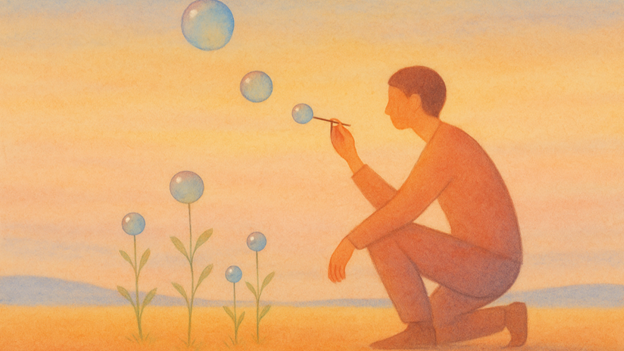
He spoke about soap bubbles, foams, liquid crystals, forms so light and so unstable that they seem to challenge the solidity of the world. And yet, by observing them, he revealed the beauty of a living balance: an order born from movement, a force woven with fragility.
This reflection takes inspiration from this way of looking at matter with curiosity, humility and wonder, to explore what this physics of the living can tell us about supervision.
A bubble: a world in balance
To look at a soap bubble is to witness a tiny miracle. A simple film of water which, by the tension of its surface, becomes a vibrant space, suspended between inside and outside. It holds because it adjusts itself at every moment to align.
And what if our supervision spaces were made of the same invisible material? Relational bubbles, fragile and precious, where we learn to inhabit the tension between structure and freedom, words and silence, knowledge and exploration.
The delicate art of the frame
In physics, surface tension depends on an equilibrium of opposite forces. It is this tension, not too strong, not too weak, that allows the bubble to exist.
In the same way, in supervision, the frame seems to act like a living membrane. If it becomes too rigid, the process explodes. If it becomes too loose, everything dissolves. But when the tension is right, containing without constraining, something organic appears trust, speech, presence. A fragile balance, a source of vitality.
Transitions: when the form hesitates
De Gennes loved observing those moments when matter changes its state. Water becoming vapor. Liquid crystals reorganizing. Soft transitions, often invisible, where the system reinvents itself without losing some continuity.
In supervision, there are also these passages. A new understanding, a softened emotion, a shifted perspective. A whole world that changes its shape in a subtle way. These transformations cannot be taught; they can only be accompanied. They require fine attention, warm presence, and the quiet trust that the living knows where it goes.
Interfaces: where meaning is born
De Gennes was fascinated by interfaces, those meeting zones between two environments: air and water, solid and fluid. There, matter becomes the most inventive.
Our spaces of supervision are also made of interfaces: between self and other, experience and awareness, the coach’s practice and the supervisor’s gaze. These boundaries are zones of creation. There, meaning emerges as a living phenomenon.
Watching before understanding
Physicists observe for a long time before explaining; rushing would close the possibility of seeing.
Supervision seems to be the same. Before understanding, we can watch. Before interpreting, we can listen. This peaceful curiosity transforms the session into a laboratory of the living: a shared observation space, where meaning reveals itself little by little, through the movement of the relationship.
Towards an ecology of fragility
Everything that lives is fragile and if this would be exactly what allows it to endure. Rigid systems end up breaking. Living systems breathe, oscillate, adjust.
Maybe supervision is, deep down, an ecology of fragility: a practice that takes care of moving balances, that learns to read the micro-variations of the living, that sees fragility as the very signature of life.
An invitation
Next time you are in supervision, imagine you are observing a soap bubble. Watch how it holds. How it trembles, takes colors, reflects everything around. How it bursts leaving only the air it carried.
Maybe as supervisor our role is not to preserve it, but to marvel that it could exist, so full, so fragile, so alive.
And you, in your supervision spaces, where do you perceive this ecology of the fragile, this living tension between containing and letting be?
Martine George
on LinkedIn
https://www.linkedin.com/in/dr-martine-george-14b7b31